
25 November 2026 | Blog
Winter readiness: close passenger communication gaps before disruption hits
25 November 2026 | Blog
Winter readiness: close passenger communication gaps before disruption hits
Disruption will never be fully predictable, particularly in winter when weather conditions can change within minutes. Airlines can't prevent every delay or cancellation, but you do have control over how you communicate with and support passengers when plans change.
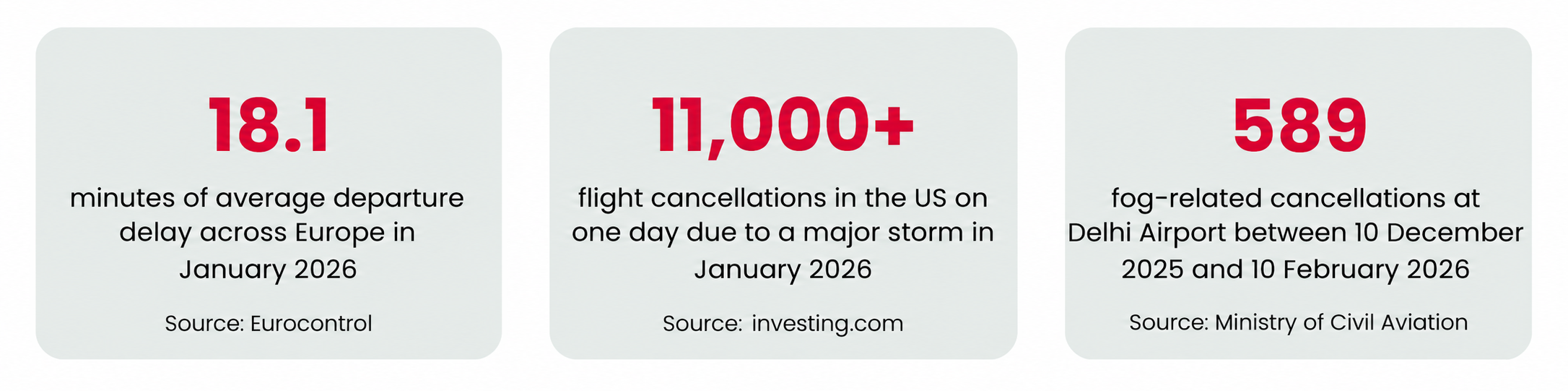
In January 2026, average departure delays across Europe reached 18.1 minutes per flight, up from 14.6 minutes a year earlier. During the winter of 2025–26, snow affected Amsterdam Schiphol and low visibility disrupted Paris Charles de Gaulle, while Heathrow faced restrictions caused by low visibility and high winds.
Winter weather also caused major disruption beyond Europe. In the US, a major storm led to more than 11,000 flight cancellations on 25 January 2026 alone. In India, the Ministry of Civil Aviation reported 589 fog-related cancellations at Delhi Airport between 10 December 2025 and 10 February 2026.
Winter disruption isn't going away, but airlines can prevent known communication gaps from making recovery harder than it needs to be.
When disruption hits, information becomes part of the recovery
During disruption, your operations teams are managing aircraft, crews and connections while recovery plans continue to change. But the decisions made inside the operation still need to reach the people whose journeys have been impacted.
A cancelled flight is a good example. A passenger with an onward connection needs a revised itinerary, while a family stranded overnight needs accommodation details. Someone requiring accessibility assistance needs to know their support is still in place. A general flight-status update doesn't answer all those questions.
Travel disruption over the winter season can also hold additional emotion, as many passengers are travelling to spend the holidays with family or friends. A missed connection could mean missing a long-awaited gathering, making clear information about alternative arrangements, available assistance and details on what happens next even more important.
When the answers are not proactively provided, passengers turn to airport staff and contact centres. Colleagues spend time explaining arrangements that may already be confirmed instead of helping people whose circumstances need individual attention. Those enquiries add handling costs to an operation already paying for rebooking, accommodation and other assistance. For passengers, uncertainty adds frustration and can undermine trust and long-term loyalty.
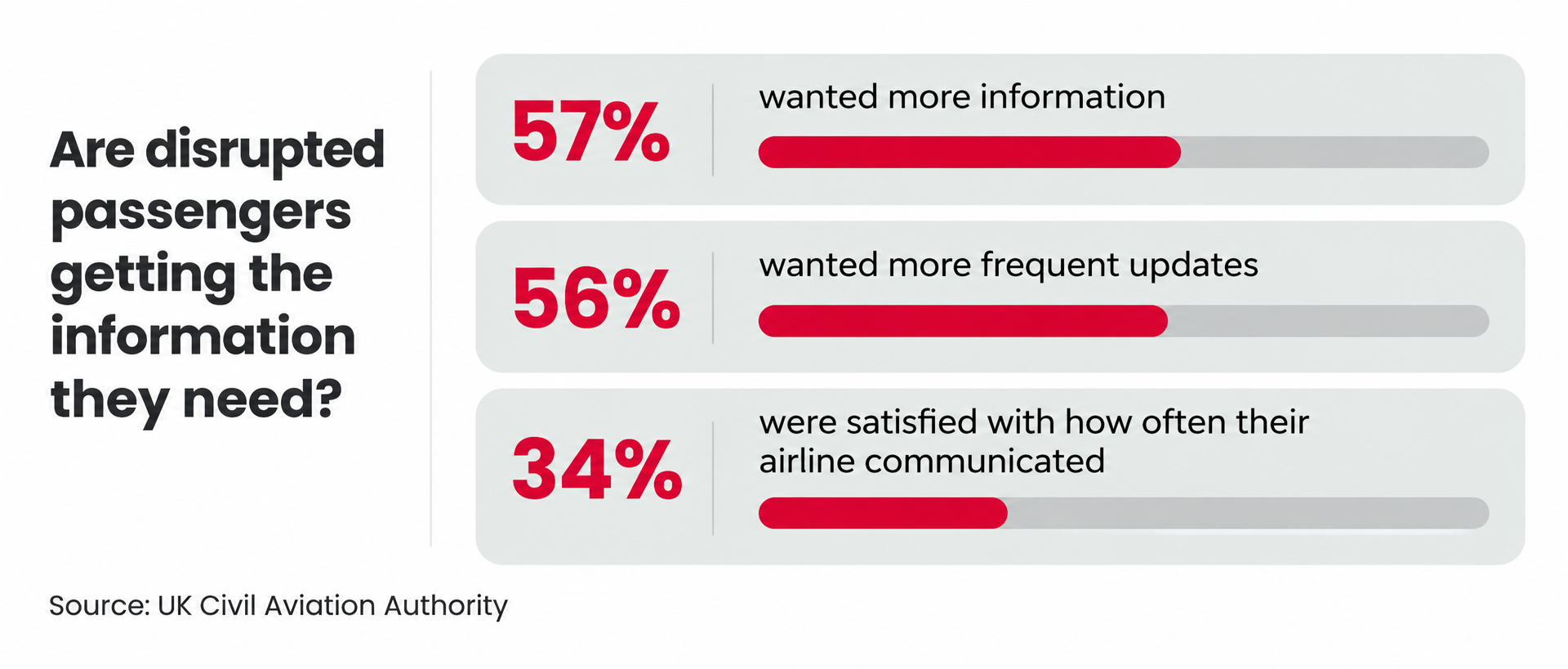
Research commissioned by the UK Civil Aviation Authority highlights the gap between the information passengers receive and what they need: 57% of disrupted passengers wanted more information, 56% wanted more frequent updates, and only 34% were satisfied with how often their airline communicated with them.

"Real-time updates are now the bare minimum our customers expect from us."
Edward Thorstad,
SVP of Customer Care, Norwegian
Faster notifications aren't enough if passengers are still left wondering what's happening to their journey. They need information they can act on: the new itinerary, how to access assistance or when to expect a further decision. Otherwise, a message is sent but the reason to contact the airline remains.
Start with the gaps that are already creating work
One place to start is the time between a recovery decision and the update passengers receive. A replacement itinerary may be confirmed in the reservation system, but one of your team still has to compile passenger details, prepare a message or transfer information between systems before customers hear about it. The airline has arranged the next step, yet passengers are still waiting for the answer.
System challenges like these are often included in wider CRM or digital transformation plans. Those programmes can improve how systems work together, but airlines shouldn't have to wait for a large-scale project to address communication gaps that create unnecessary work, add costs and leave passengers without timely information during disruption.
Recent events have shown why that flexibility matters. When airspace closures affected airlines this year, 15below helped customers get new passenger messaging live in weeks rather than months. The recent US CDC attestation requirements also demonstrated how quickly airlines may need to adapt their passenger communications.

"When we're talking about winter readiness, I'd look beyond whether an airline can send a disruption notification. What happens when several flights change at once? Who has the latest information, who decides what passengers need to know, and how much manual work is involved before that information reaches them? Those are the questions that help identify where a targeted improvement could make a real difference."
Mike Blanchard-Heal,
Head of Account Management, 15below
Start with journeys that generate avoidable contact, such as confirmed rebooking details that take too long to reach passengers or assistance that still has to be requested by phone. Where your airline already holds reliable information, targeted changes can remove repetitive handling without waiting for every part of a larger programme.
Human judgement remains essential during disruption, particularly when recovery plans are changing and passengers need information they can rely on. Operational teams need to assess what's happening, decide when information is ready to share and ensure passengers receive the right guidance for their circumstances.
With a platform like 15below's, airlines can combine that oversight with pre-approved templates and automated workflows. Teams can approve messaging, decide when communications should be triggered and step in when circumstances require a different approach. Once those decisions are made, the platform can deliver updates to affected passengers without teams having to prepare and send each notification individually.
The aim is to reduce repetitive handling without removing operational control. Any new workflows should follow the airline's approval processes, work with its existing systems and be able to adapt as wider technology projects progress.
The value goes beyond fewer calls
During disruption, your passengers need more than information about what's changed. They also need practical assistance without having to contact the airline to request support they're already eligible for. Every unnecessary interaction adds to the pressure on teams managing recovery and reduces the confidence and trust of your passengers.
During major air traffic control disruption in June 2024, Ryanair issued 175,196 refreshment vouchers automatically through its integration with 15below and iCoupon. When a flight reaches an agreed delay threshold, the 15below platform uses reservation information to identify eligible passengers, connects with iCoupon to enable digital vouchers on their boarding passes and sends notifications explaining the amount available and where it can be redeemed. This allowed Ryanair to provide assistance to large numbers of passengers while its teams were managing widespread disruption.
Passengers could access refreshments using the boarding pass they already had, rather than contacting the airline to request an individual voucher. For Ryanair's teams, automating that process reduced the need for manual handling and created more capacity to help people whose circumstances required personal attention. Providing practical support quickly and proactively can also offer reassurance during a stressful situation, helping passengers feel informed and cared for by their airline.
We've explored the wider financial implications in our article on how better communication reduces the operational cost of airline disruption.
Get the process ready before winter tests it
Known communication gaps don't become less costly because they're scheduled for a future project. When winter weather disrupts several flights at once, every additional manual step is repeated across more passengers, generating avoidable enquiries and consuming capacity when operational teams need it most. This adds to operational costs and increases the risk of important communications being delayed, missed or sent with incorrect information. For passengers, those failures can undermine confidence in the airline, potentially influencing their loyalty long after the disruption has passed.
Many airlines have already seen where these pressures build during previous disruption events. Those journeys deserve attention now, particularly where information is available but slow to reach passengers, or routine assistance still requires individual handling.
Working with airlines like Ryanair, Norwegian, and British Airways, we've seen how important it is to close the gap between an operational decision and the information passengers receive during disruption. At 15below, we help airlines automate that process, using flight and booking data alongside pre-approved templates and automated workflows to identify affected passengers and deliver timely, relevant communications. It reduces manual work for operational teams and helps passengers clearly understand what happens next, what options are available to them and provides much needed reassurance at a time of severe stress.
If you're reviewing your winter readiness, speak to the 15below team about the passenger communication journeys worth prioritising.


