
17 July 2026 | Blog
Operational passenger communications: choosing the right tool for the job
17 July 2026 | Blog
Operational passenger communications: choosing the right tool for the job
When disruption happens, passengers don’t compare systems, they compare experiences. They don’t care whether a message was triggered by a CRM, a marketing platform or an operations system. They care whether they received accurate information, at the right time, through the right channel.
For airlines operating in an environment of record passenger volumes, increasing operational complexity and constant public scrutiny, operational communications are no longer a technical consideration. They are a commercial decision that directly influences cost to serve, loyalty and brand perception.
When communication works, it reduces uncertainty, protects trust and helps passengers make informed decisions quickly. When it fails, confusion spreads quickly across contact centres, airport teams and social channels. The impact of this is measurable with costs rising, CSAT and NPS scores declining and long-term brand confidence eroded.
In disruption, communication becomes the single most visible expression of an airline’s operational control.
Marketing and CRM systems have a role, but not in operational delivery
Marketing automation and CRM platforms are critical to the customer journey. They help build brand awareness, track engagement, support loyalty and enable revenue activation.
At 15below, we integrate with more than 100 systems, including reservation platforms, CRMs, loyalty programmes and departure control systems. This ensures operational notifications can be supported with the right data at the right time.
Operational communications require capabilities that marketing systems are not designed to deliver at scale. Operational messaging requires real-time triggers, PNR-level rule logic, surge capacity and resilient multi-channel orchestration whereas marketing platforms are optimised for scheduled campaigns, audience segmentation and promotional messaging.
That distinction becomes critical when disruption occurs and thousands of passengers need to be informed simultaneously.
Operational communication is not about just sending messages. It is about maintaining clarity and control when operations are under pressure.
Deliverability is not a marketing metric, it is an operational safeguard
Global inbox placement benchmarks continue to sit in the mid-80% range, meaning a considerable share of emails never reach the inbox. For promotional content that may be tolerable. For cancellations, gate changes or rebooking instructions, it is not acceptable.
Disruption already places passengers in a situation of uncertainty. When communication fails to reach them, that uncertainty grows quickly. Passengers begin searching for answers elsewhere through third-party apps, search engines or social media, where information may be incomplete, inconsistent or just inaccurate. In those moments, the airline risks losing control of the narrative.
In operational communications, silence is rarely a good thing. If passengers don’t hear from their airline, they assume the airline either doesn’t know, doesn’t care, or just isn’t in control.

‘Silence is the most expensive message you can send.’
Vimal Kumar Rai,
Co-founder and Managing Partner, Commercial Excellence Partners
Regulators have repeatedly highlighted that information gaps during disruption increase passenger anxiety and results in travellers missing opportunities to resolve their own situation. Contact centres experience volume spikes, airport teams absorb additional pressure, and customer satisfaction declines.

“When faced with disruption, passengers need to know what they are entitled to, and airlines need to give clear, timely information. Airlines that recognise the importance of good communication when something goes wrong can transform loyalty-damaging experiences into trust building moments that reduce passenger distress.”
Selina Chadha,
Group Director for Consumers & Markets at the UK Civil Aviation Authority.
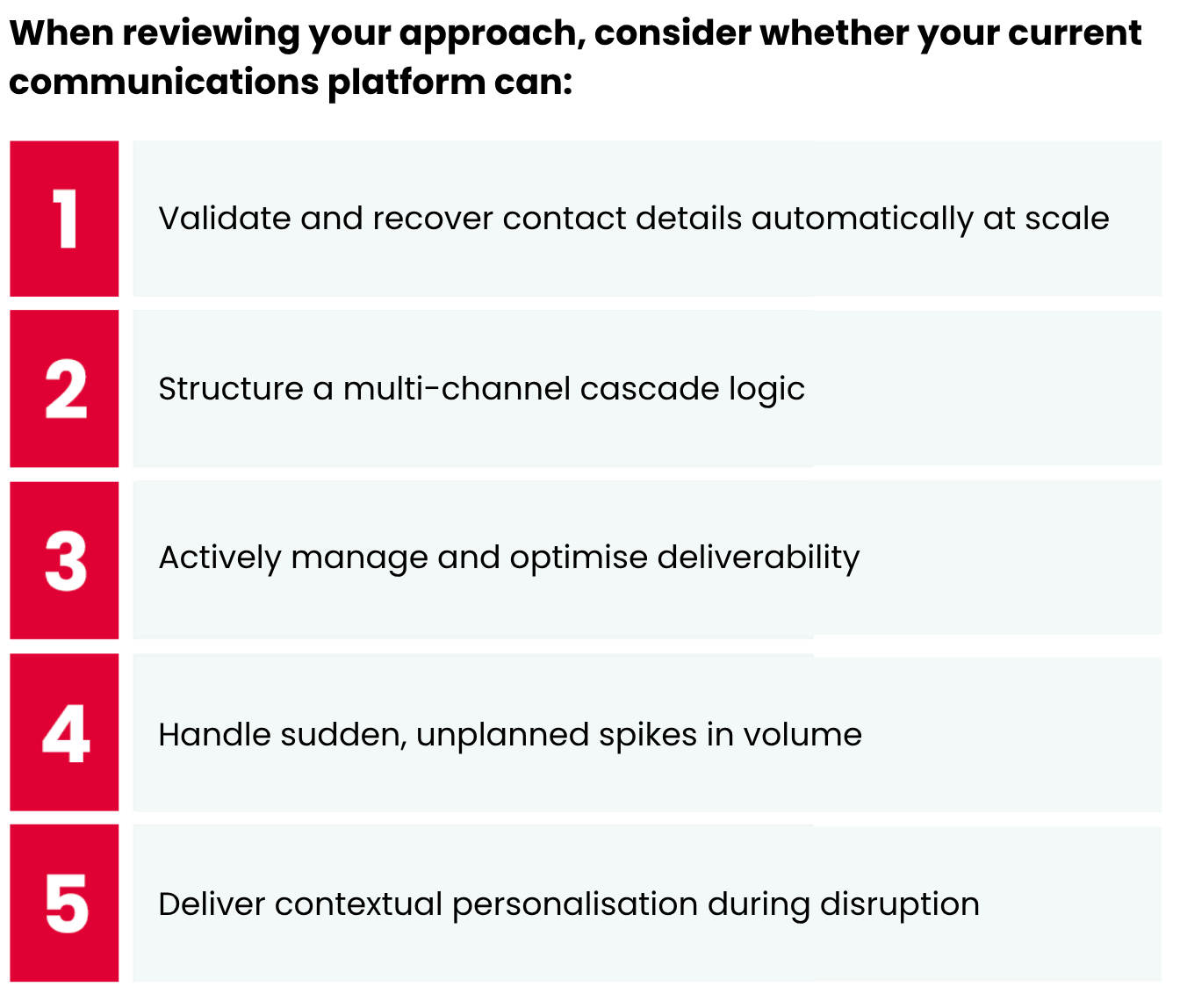
Operational communications platforms are built to actively manage deliverability through reputation monitoring, infrastructure resilience and continuous performance optimisation, specifically designed for high-volume, time-sensitive messaging.
Deliverability is not a one-time configuration. It is an operational discipline.
For a deeper look at the realities of email performance for airlines, read our article on getting email deliverability right.
The contact detail gap for airlines
A significant proportion of airline bookings are made through third parties, where contact details are not always fully shared. Some passengers also provide incorrect information or use email addresses they rarely monitor.
This creates a structural reach problem, and it is one of the reasons operational communications require specialist capability.
The 15below platform validates contact information at PNR level and, where necessary, searches connected systems such as CRM and loyalty platforms to recover missing details automatically, in seconds and at scale.
Without this kind of automation, the gap between “sent” and “received” widens, particularly when disruption hits and communication volumes increase dramatically.
Omnichannel is now a baseline expectation for passenger communications
Passenger messaging behaviours have evolved rapidly in recent years, and expectations around immediacy and convenience have changed with them. Relying solely on one-way email or SMS is no longer sufficient.
Best-in-class airlines increasingly use structured cascade models, allowing them to define the order and timing of communication channels based on urgency, engagement signals and regional preferences. For example:
- Send email first
- If unopened within a defined window, trigger SMS
- If still unacknowledged, escalate to WhatsApp, social messaging or app push notification
This approach increases reach rates while controlling cost, reducing pressure on contact centres and aligning with regional messaging preferences.
More importantly, it ensures passengers receive information through the channels they are most likely to engage with during disruption.
If you are reviewing engagement strategy more broadly, our article on addressing dropping passenger engagement rates explores why traditional approaches are losing impact.
Personalisation is contextual, not cosmetic
Operational personalisation extends far beyond inserting a passenger’s first name into a message. True personalisation requires adapting content, timing and channel based on real-time operational context, including:
- Stage of journey and proximity to departure
- Time zones and language preferences
- Special service requirements and travelling party composition
- Loyalty status, disruption history and available rebooking options
This level of contextual communication reflects a broader shift in passenger expectations. Travellers increasingly expect airlines to recognise their circumstances and provide guidance that is relevant to their situation.
During disruption, this approach is not simply about convenience. It is about empathy.
Clear, personalised guidance helps passengers understand their options, reduces anxiety and enables them to take action quickly. When delivered effectively, operational communications can transform disruption from a moment of frustration into an opportunity to strengthen trust.
Consumer research continues to show that personalised experiences materially influence purchase and loyalty behaviours. In aviation, that expectation applies just as strongly during disruption. Delivering this level of relevance requires deep integration, real-time data access and a rule-based logic engine capable of dynamically assembling content within intelligent templates.
Building in-house: understanding the true scope
Over the past 25 years, we have met many airline teams who initially believed passenger notifications were relatively simple to build internally.
In practice, a market-leading operational communications platform must account for far more than message generation. It requires:
- Resilience under sudden volume surges
- Deliverability monitoring and reputation management
- Multi-channel orchestration and cascade logic
- Security, compliance and disaster recovery
- Continuous monitoring, optimisation and support
The question is not whether your team can send messages. It is whether those messages will reach passengers reliably, at scale, and under operational pressure.
Proven at scale
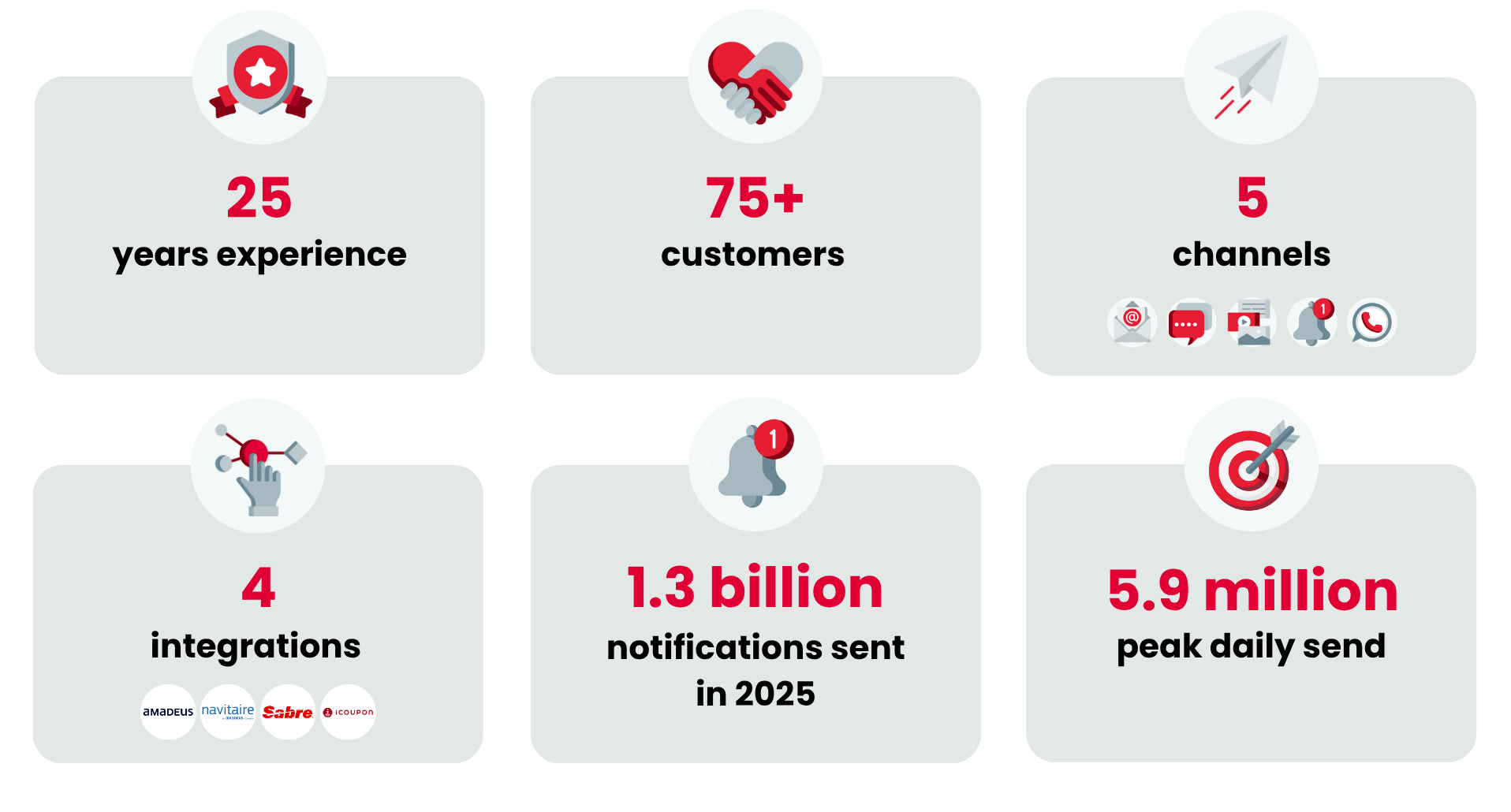
The 15below platform supports more than 75 travel brands globally and helps airlines deliver over 1.3 billion passenger notifications every year.
Long-standing partnerships with major reservation systems, including Amadeus and Navitaire, ensure robust integrations, while resilient infrastructure and disaster recovery processes safeguard both data and operational continuity.
When disruption occurs, reliability is not a feature. It is the foundation.
Choosing the right tool
Operational communications directly influence customer satisfaction, NPS, cost to serve, retention and future booking intent.
When communication works well, passengers feel informed and in control. They can make decisions quickly and trust the information they receive from their airline. That confidence then builds into loyalty.
As we’ve discussed, when it fails, confusion spreads quickly. Passengers search elsewhere for answers, contact centres face increased pressure and brand perception suffers.
Explore the full guide
If you are reviewing your operational communications strategy, our guide 'The right tool for the job' explores how airlines structure messaging platforms, channels, and deliverability to ensure passengers receive the right information at the right time. Read here.