
31 July 2026 | Blog
Why an omnichannel approach is essential for airline passenger communications
31 July 2026 | Blog
Why an omnichannel approach is essential for airline passenger communications
SMS requirements in Türkiye and Malaysia highlight a challenge that goes beyond standard compliance. Airlines also need to consider what happens to the communication journey when a communication can no longer include the information or links a passenger needs.
In Türkiye, new requirements apply to URLs in certain messages, while the Malaysian rules regulate hyperlinks and other digital content. These measures are intended to reduce fraud and protect consumers. At the same time, they show why airlines cannot rely on one channel to support passengers throughout their journey.
If a channel becomes restricted, unavailable or less effective, can the airline’s communication journey continue? Can the passenger continue their journey without needing to reach out for support?
Changing SMS requirements create a wider challenge
Measures introduced by Türkiye’s Information and Communication Technologies Authority, the BTK, took effect in April 2026. Under the changes, local operators block SMS and MMS messages sent from abroad if they contain URLs or internet links.
The requirements also prevent companies without a local entity from sending messages containing URLs to Turkish numbers. They also introduce requirements around sender ID registration.
In Malaysia, full enforcement of SMS content restrictions began in September 2024. Messages containing hyperlinks, callback or contact numbers, and requests for personal information are blocked.
The requirements are not identical, but they present the same challenge for international airlines. Content that works effectively in one market may need to be adapted in another.

“These changes are not only a compliance issue. Airlines also need to think about resilience and whether the passenger journey can continue when one channel is restricted or unavailable.”
Gemma Maidlow,
Head of Product Solutions
Why airlines need more than a single channel
SMS remains an important channel for airlines, particularly when information needs to reach passengers quickly. It is widely accessible and useful for urgent updates such as cancellations, gate changes and revised departure times.
But the message itself may not be enough. A passenger might then need to view a revised itinerary, choose another flight, access a digital boarding pass or request a refund. If the SMS cannot direct them to the next step, another channel needs to take over.
Without it, passengers are left to find the information themselves. They may call the airline, speak to airport teams, check third-party platforms or turn to social media. This creates more work at a time when operational teams may already be under significant pressure. There is also no guarantee that the information passengers find elsewhere will be complete, up to date or even reliable.
And regulation is only one reason a channel may not perform as expected. Contact information can be missing or inaccurate. Messages can fail to deliver, passengers may not engage with the selected channel and individual services can become temporarily unavailable.
Relying on one channel therefore creates a single point of failure within the passenger journey.
Keeping the communication journey connected
An omnichannel approach is not about repeating every update across SMS, email, push notifications and other channels.
Each channel should have a clear purpose. SMS may be the best way to alert a passenger quickly, while email can provide more detail and an app can give them access to the self-service options you want to present. The combination will depend on the situation, the passenger and what they need to do next.
According to Salesforce’s State of the Connected Customer report, 71% of customers prefer to use different communication channels depending on the context. For airlines, this reinforces the importance of selecting each channel according to the urgency of the message, the level of detail required and the action the passenger needs to take next.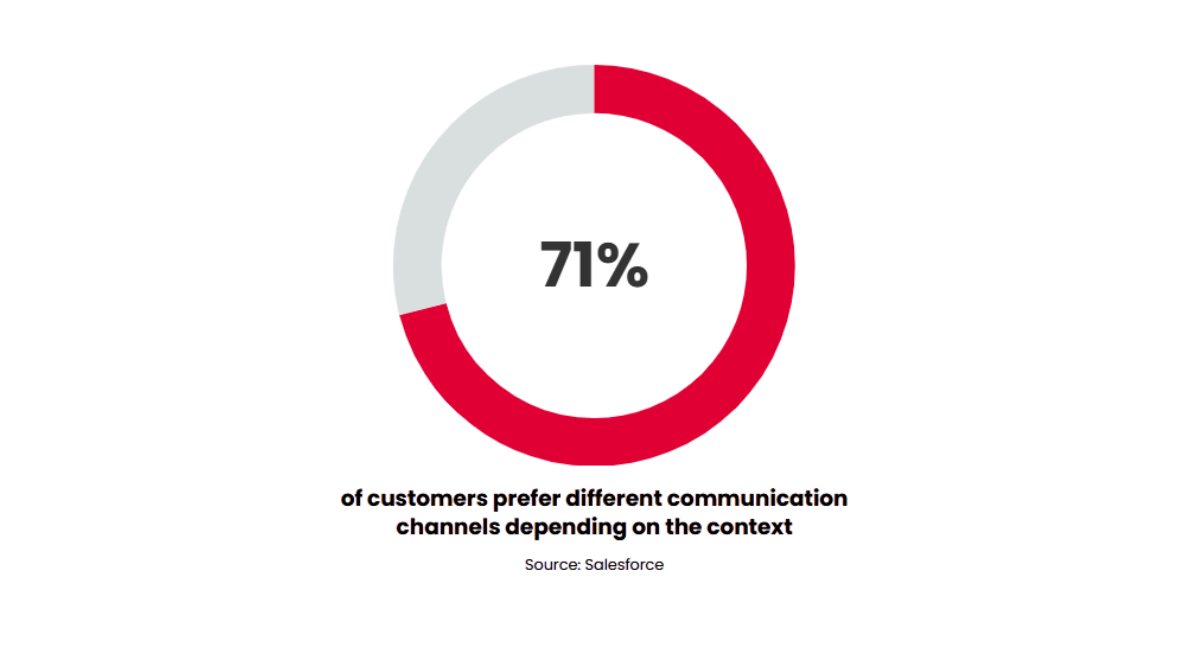
If the passenger does not engage with the first message, the communication workflow can move to another available channel or send a reminder at the appropriate time.
This allows each channel to perform a specific role without disrupting the wider journey.
When communications use shared operational data and business rules, airlines can reduce duplicated or conflicting messages, tailor information to the passenger’s circumstances and automate the next appropriate step.
This becomes particularly important during disruption. Urgent information can be delivered through the fastest available channel, with more detailed guidance and self-service options provided elsewhere.
Passengers receive clearer, more relevant support, while Customer Care, airport and operational teams face less avoidable pressure.
Building a more resilient communication strategy
Airlines need to consider SMS, email, app push, WhatsApp and other digital channels as parts of the same communication journey. When those channels are coordinated, the airline has more flexibility if regulations change, contact information is incomplete or a particular service becomes unavailable.
The aim is not to send more messages. It is to make sure passengers still receive the information and support they need when one channel cannot do the whole job.
It is not enough for airlines simply to offer multiple channels. Those channels need to work together so passengers remain informed, understand what to do next and can continue their journey during disruption.
At 15below, we help airlines deliver coordinated and personalised passenger communications across every stage of the journey.
To explore this topic further, watch our webinar on the importance of an omnichannel approach and read our white paper, The future of disruption communications.
To discuss how a more resilient communication strategy could support your airline, get in touch with our team.